All-sky transit surveys have discovered a rare class of brown dwarfs transiting active, flare-prone M dwarfs on short orbits of less than 10 days. These systems offer a unique opportunity to study how powerful stellar activity shapes brown dwarf atmospheres, and by analogy, exoplanet atmospheres across a wide range of masses.
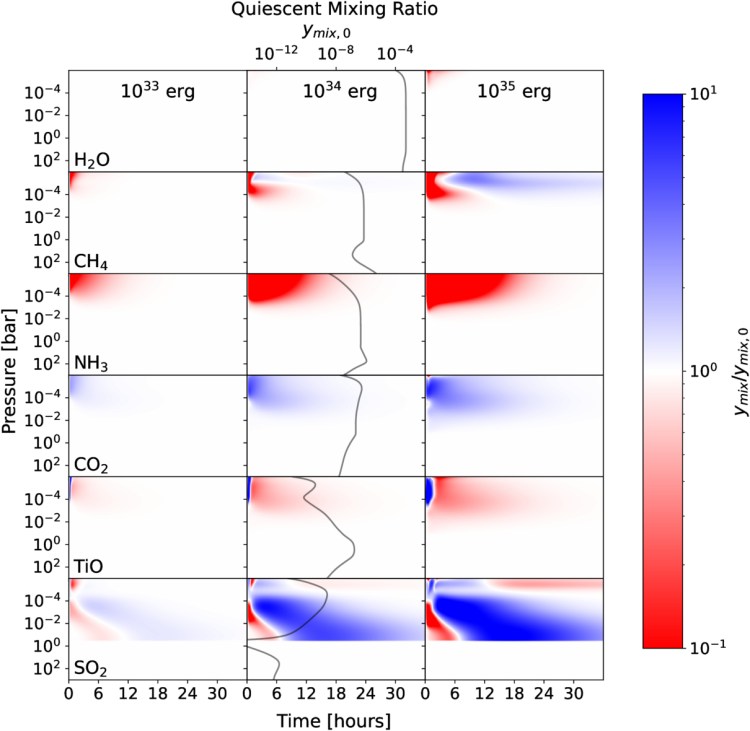
In a recent paper, I modeled the photochemical and thermal changes to a brown dwarf atmosphere driven by M dwarf superflares. Detecting these changes observationally in high-resolution spectra would provide direct insight into how host stars shape the atmospheres of both companion brown dwarfs and exoplanets.
I am currently pursuing ground-based observational programs to search for chemical and thermal atmospheric signatures attributable to stellar activity.
 Aidan Gibbs, Ph.D.