A current list of my authored papers and presentations is available here.
Searching for infrared auroras in brown dwarfs
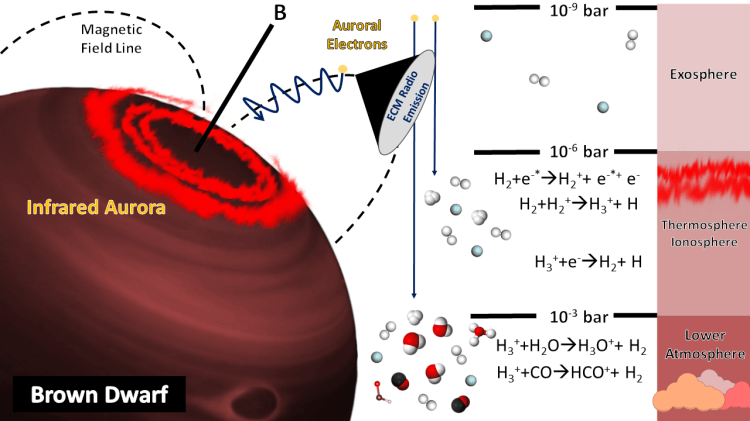
Conditions in the upper atmospheres of giant exoplanets and brown dwarfs are strongly influenced by the properties of their magnetospheres. One of the most visible manifestations of the atmosphere-magnetosphere interrelationship are auroras, the precipitation of energetic charged particles along magnetic field lines into the atmosphere, which produces emission across a broad range of the electromagnetic spectrum from the x-ray to radio. In giant planets and brown dwarfs, auroras are an important component of upper atmospheric chemistry and energy budget.
A long term project of mine has been searching for infrared auroral signatures in free-floating brown dwarfs with known auroral radio emissions. The processes that generate auroras in these objects and their impact on atmospheric structure and chemistry are essentially unknown. Detection of auroral H3+ emission in particular would provide a common tracer for comparing the upper atmospheres of brown dwarfs with those of our own solar system’s giant planets.
I have previously published a paper on this topic – Gibbs et al. 2022. Publication of JWST Cycle 3 observations on this topic is in preparation – GO 5814.
Modelling the impact of stellar flares on short-period brown dwarf companions
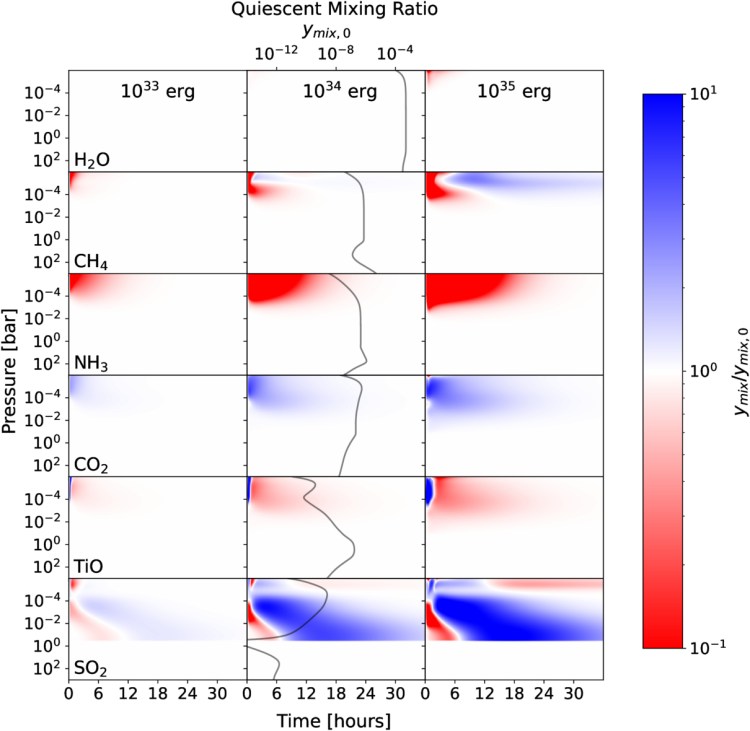
All-sky transit surveys have discovered a rare class of brown dwarfs transiting active, flare-prone M dwarfs on short orbits of less than 10 days. These systems offer a unique opportunity to study how powerful stellar activity shapes brown dwarf atmospheres, and by analogy, exoplanet atmospheres across a wide range of masses.
In a recent paper, I modeled the photochemical and thermal changes to a brown dwarf atmosphere driven by M dwarf superflares. Detecting these changes observationally in high-resolution spectra would provide direct insight into how host stars shape the atmospheres of both companion brown dwarfs and exoplanets. I am currently pursuing ground-based observational programs to search for chemical and thermal atmospheric signatures attributable to stellar activity.
High-contrast imaging of brown dwarfs, giant exoplanets, and debris disks
Currently, only brown dwarfs or young giant planets far from their host stars can be directly imaged due to the high contrast between planet and star and the small separations when viewed from Earth. Blind searches have shown these objects are rare and unlikely to be detected around any randomly selected star. I am a member of Tim Brandt’s Hipparcos-Gaia Catalog of Accelerations collaboration, which attempts to circumvent the issue of rarity by identifying stars more likely to host detectable planets based on astrometric accelerations seen by the Hipparcos and Gaia satellites.
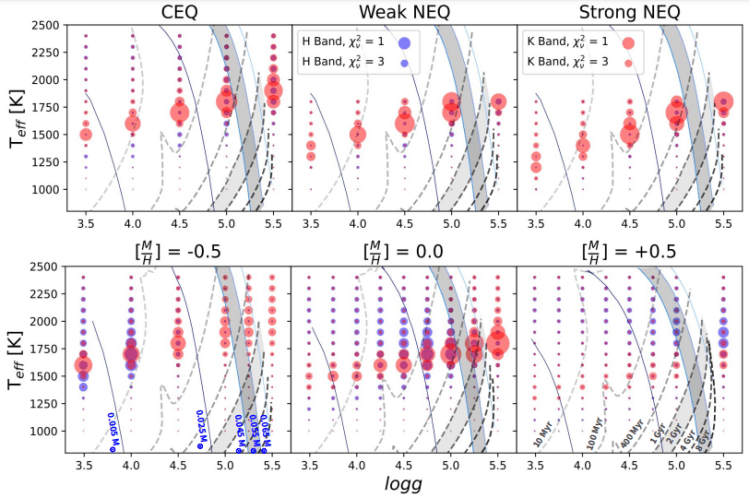
As part of this collaboration, I have published follow-up spectroscopic characterization of the brown dwarf companion HD 33632 Ab. HD 33632 Ab is a “benchmark” brown dwarf, because it’s mass and age can be constrained independently of substellar evolution models using astrometric accelerations, radial velocities, and stellar age indicators from the host star. This makes it a valuable test for brown dwarf evolution models. My work highlights the complexity of brown dwarf spectra compared to existing grid models and the importance of considering clouds and disequilibrium chemistry for precise evolution models. (Gibbs et al. 2024)
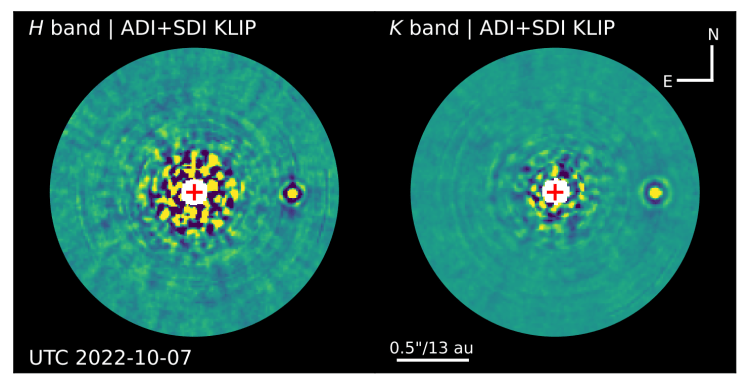
For my undergraduate thesis, I published an analysis of high-contrast images of the debris disk around the star HD 115600 with VLT/SPHERE. Debris disks are interesting as they are direct evidence that planet formation has occurred around a star, and they can be visibly shaped by otherwise unseen planets. HD 115600 likely still hosts a yet undiscovered planet hidden within the disk.
Simulation for the High-resolution Infrared Spectrograph for Exoplanet Characterization (HISPEC) at Keck
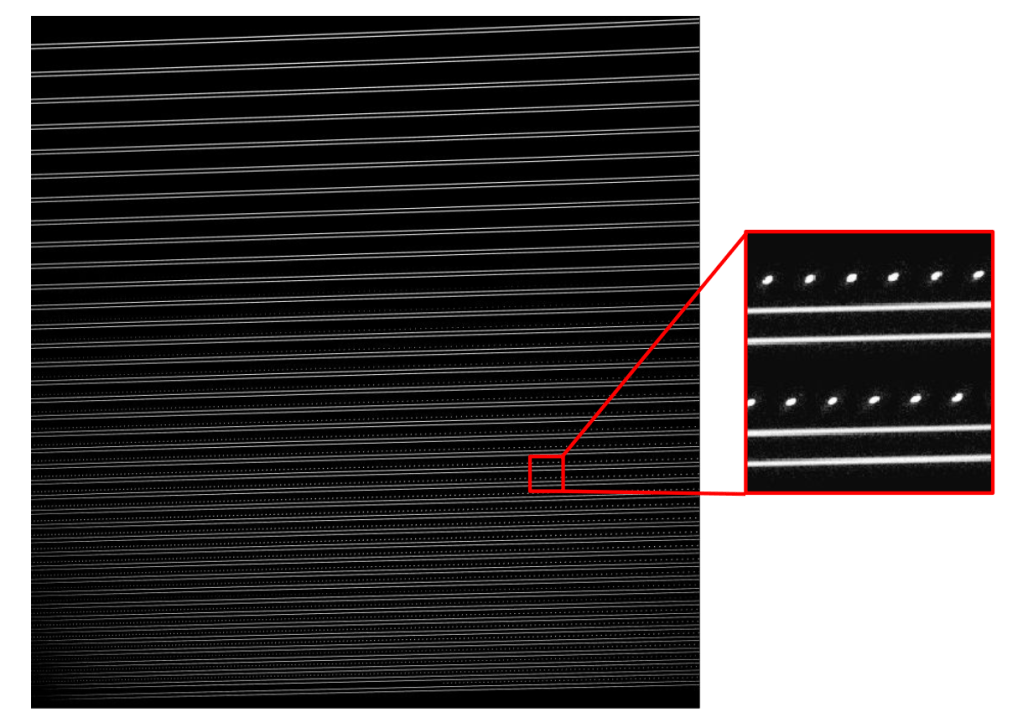
High-resolution infrared spectroscopy is a key technology for the discovery of potentially habitable planets around cool stars via the radial velocity method. Additionally, it allows for detailed atmospheric characterization of both transiting and non-transiting planets revealing information about planetary formation and evolution. Currently, I am involved with the development of end-to-end instrument simulations of the future HISPEC instrument for Keck. HISPEC builds off technology from the PARVI and KPIC instruments at Palomar and Keck, and is also planned to be a first light instrument for the Thirty Meter Telescope (TMT) and part of the MODHIS instrument suite.
Searching for Earth-sized planets amenable to characterization with the James Webb Space Telescope
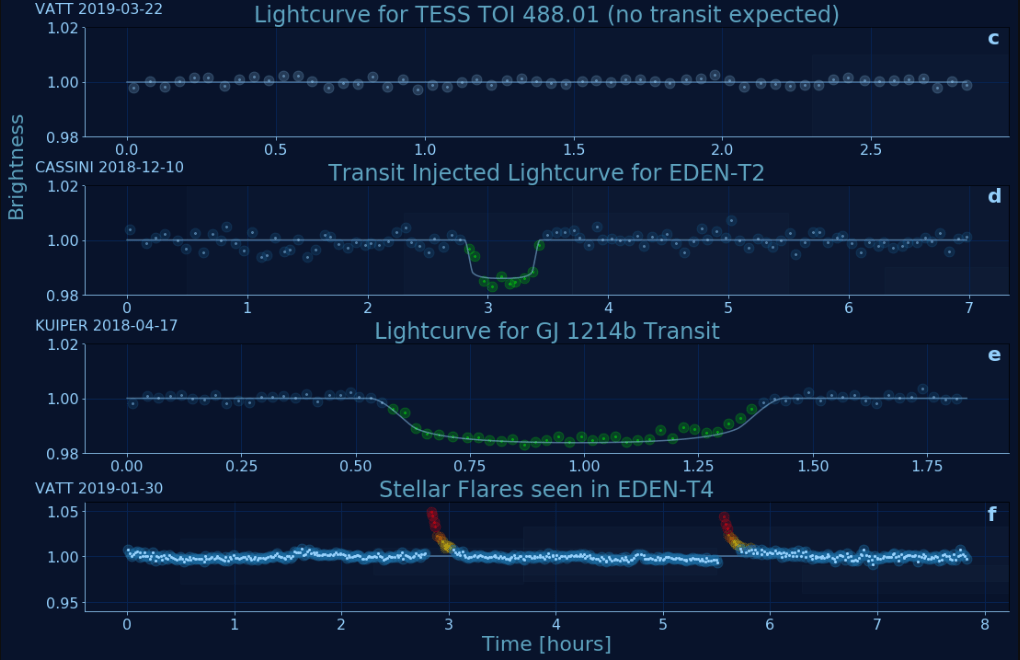
As a post-baccalaureate experience between my undergraduate and graduate degrees, I worked as a telescope operator and researcher for Project EDEN. EDEN is a program to search for transiting Earth-sized planet around ultracool M dwarfs that would be good targets for further characterization with JWST but are unlikely to be detected by the Transiting Exoplanet Survey Satellite (TESS). While no planets have yet been discovered (detection is limited primarily be the geometric probability of transit), the project has resulted in useful limits for many otherwise untargeted stars. The observations also have provided observations of flares on ultracool dwarfs at a much higher temporal cadence than is achieved by TESS or Kepler. During my year on this project, I gained over 50 nights of observing experience on one to two meter telescopes.
 Aidan Gibbs, Ph.D.