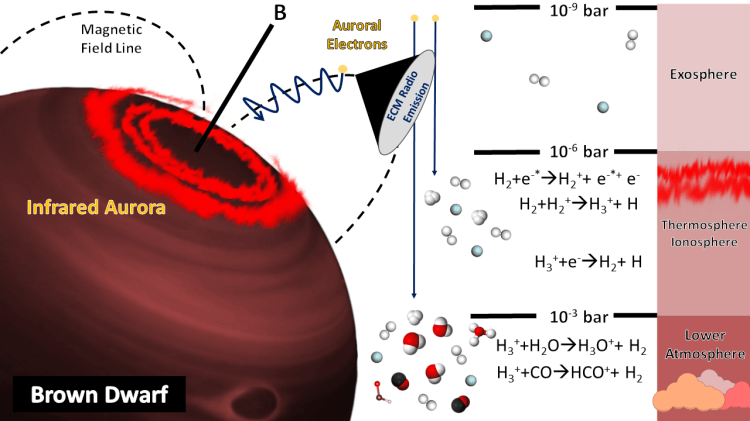
Conditions in the upper atmospheres of giant exoplanets and brown dwarfs are strongly influenced by the properties of their magnetospheres. One of the most visible manifestations of the atmosphere-magnetosphere interrelationship is auroras, the precipitation of energetic charged particles along magnetic field lines into the atmosphere, which produces emission across a broad range of the electromagnetic spectrum from the x-ray to radio. In giant planets and brown dwarfs, auroras are an important component of upper atmospheric chemistry and energy budget.
A long term project of mine has been searching for infrared auroral signatures in free-floating brown dwarfs with known auroral radio emissions. The processes that generate auroras in these objects and their impact on atmospheric structure and chemistry are essentially unknown. Detection of auroral H3+ emission in particular would provide a common tracer for comparing the upper atmospheres of brown dwarfs with those of our own solar system’s giant planets.
I have previously published a paper on this topic in Gibbs et al. 2022. Publication of JWST Cycle 3 observations (GO 5814) on this topic is in preparation.
 Aidan Gibbs, Ph.D.