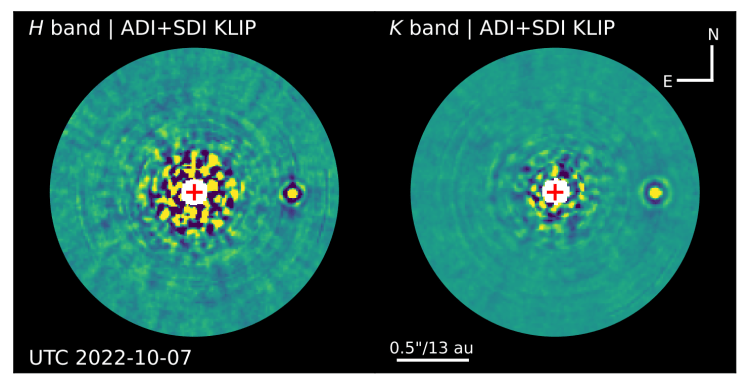
HD 33632 Ab imaged with Subaru/CHARIS in 2022 (Gibbs et al. 2024). The left and right images show H and K infrared bands respectively. The central star HD 33632 A is located at the red cross, but is occulted by a coronagraph. The brown dwarf HD 33632 Ab is visible to the right of the star.
HD 33632 Ab is one of relatively few brown dwarfs with a model-independent dynamical mass measurement, derived from astrometry in the Hipparcos-Gaia Catalog of Accelerations combined with ground-based radial velocity data. This makes it a benchmark object for substellar evolution models, as its observed spectrum can be directly compared to theoretical spectra of model brown dwarfs at the same mass and age as the host star.
In 2024, I published post-discovery follow-up characterization of HD 33632 Ab using the Subaru/CHARIS integral field spectrograph in H and K bands at R~75. The results highlight the complexity of brown dwarf spectra relative to existing atmospheric grid models, and underscore the importance of simultaneously treating clouds and disequilibrium chemistry when fitting spectra and deriving accurate evolutionary parameters. (Gibbs et al. 2024)
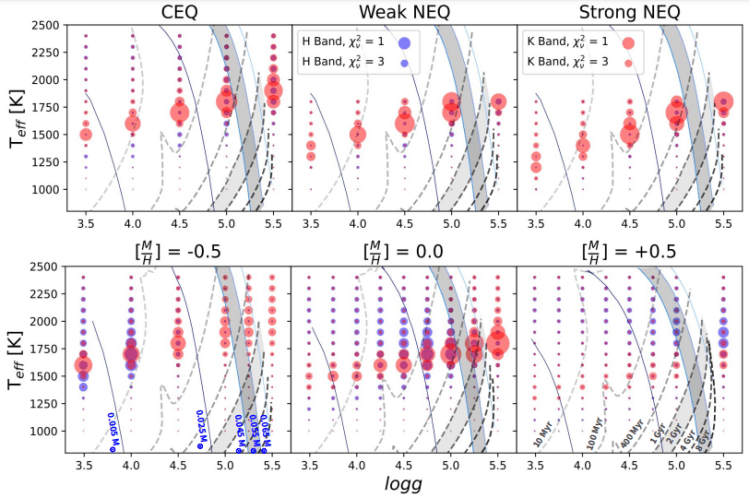
Reduced Chi2 residuals from fits of ATMO-2020 grid models (Phillips et al. 2020) (top) and Sonora-Bobcat grid models (Marley et al. 2021) (bottom) to extracted H- and K- band spectral data on HD 33632 Ab (Gibbs et al. 2024). H-band residuals are blue, K-band are red. The size of the circle is inversely proportional to the residual squared — larger symbols indicate better fits. Columns represent models of equilibrium chemistry (CEQ), weak, and strong non-equilibrium chemistry (NEQ, vertical mixing) for ATMO-2020, and varying metallicity for Bobcat models. Contours of constant mass and age are overplotted as blue shaded and gray dotted lines respectively. Regions of the preferred mass and age from dynamical constraints and stellar age indicators are shaded, with double shading in the temperature and gravity region that agrees with both the independently-constrained mass and age. The largest circles show the preferred effective temperature and gravity from spectral fitting, which can be compared with the grey shaded regions indicating previous constraints. Fits to both ATMO-2020 and Sonora-Bobcat models prefer a hotter, younger BD than the age suggests, although they may be nearly consistent within the grid spacing. Considering both clouds and disequilibrium chemistry bring the models closer to agreement with the data (not shown).
 Aidan Gibbs, Ph.D.